
Lead with Joy
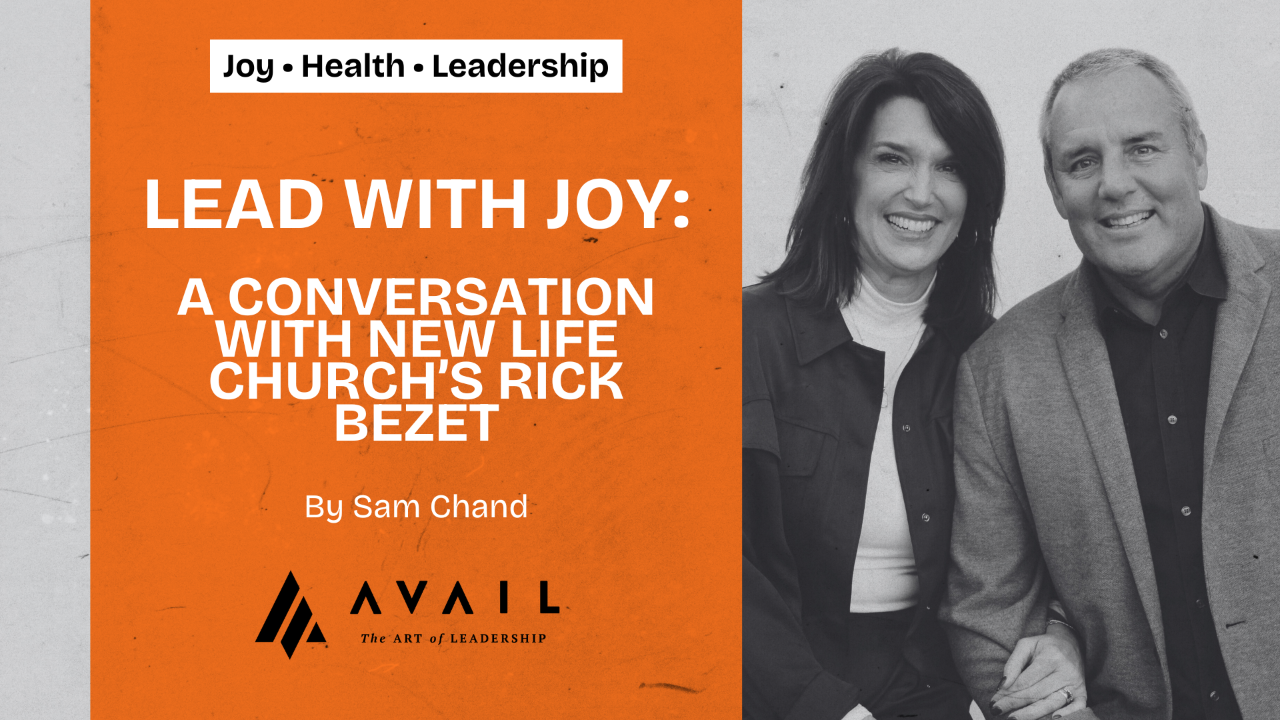
A conversation with New Life Church’s Rick Bezet
By Sam Chand
Rick Bezet is known as a pastor’s pastor—a multisite, megachurch founder, a global kingdom ambassador, a founding member of the original ARC (Association of Related Churches) team, a prolific author, an exceptional communicator, an amazing husband and dad. As great as those true accolades are, to me he is a brother and a friend I honor and respect.
Rick founded New Life Church in 2001 in Conway, Arkansas, now with 19 campuses reaching thousands each weekend. Before stepping out to plant the church, Rick served on the pastoral team at Bethany Church in Baton Rouge, Louisiana, under Pastor Larry Stockstill, where his passion for healthy leadership and relational ministry began to take shape.
I think you’ll appreciate Rick’s authenticity as he opens up about calling, family, leadership and the lessons learned on the frontlines of church planting.
Sam Chand: How did you experience God’s call to plant a church? How did He speak to you, and how did you obey?
Rick Bezet: I was serving as a pastor at Bethany Church in Baton Rouge. Part of my role involved traveling to different churches, consulting, preaching and observing how they functioned. I took a lot of notes. I noticed patterns of what made a church healthy and what caused it to drift. Over time, those notes shifted from observation to conviction: If I ever plant a church, here’s how it should be done, and here’s what we should avoid.
Eventually, I sensed the Lord prompting me to step into church planting. It wasn’t a dramatic moment, just a growing clarity and a burden that wouldn’t go away. When I finally worked up the courage to talk to my pastor, Larry, about it, I was terrified. Planting a church felt too big, and honestly, I half expected him to confirm I was crazy. Instead, he simply said, “No. Not yet.”
About a year or two later, he came back to me and said, “If you can tell me which city God is calling you to, I’ll bless it. But you need clarity.” I had preached in many cities, and I didn’t want to plant a church in a place where I was already preaching because it felt inappropriate. Arkansas wasn’t even on the list. I had never been there.
Then a businessman heard one of my messages on a cassette tape, reached out and said, “You should consider Arkansas.” I responded immediately, saying, “I’ll never move to Arkansas.” He pushed back and asked me to at least come visit, and to pray about it. So I did. When I stepped into Arkansas, I knew. The peace of God was undeniable. The call that had been forming for years finally had a location. We obeyed.
Sam: Tell us a highlight (and a “lowlight”) of the first few years.
Rick: One of the highlights of our early years was how quickly God moved. We relocated in December, and barely a month later, on February 4, we launched the church. I didn’t know a single person in Arkansas, so I expected a slow build. Instead, 504 people showed up on opening Sunday. The next weekend, 360 came. The following week, 320. We never dropped below that. From there, it just kept growing.
Because of that momentum, we began dreaming big, and God gave us the vision to plant 50 campuses across the state. We aren’t there yet, but we’ve launched 18, and every campus exists because of those early days of unexpected growth.
The lowlight was the reality underneath that excitement. We had almost no money. Our small building filled up fast, which meant multiple services every weekend. At one point I was preaching seven services in a weekend, and like a genius, I didn’t take Mondays off. I practically passed out every week. It was brutal. I still don’t know if it was the right thing, but I know it allowed us to keep reaching people when space and resources were tight.
Sam: What do you wish you had known then that you know now? What would you do differently? What would you do the same?
Rick: In the early years, my personality was turned up about 30% too strong, especially on weekends. I would walk into a room and instantly spot everything that wasn’t perfect. Things like the sound mix, the lighting or the video angles. Then I would go straight to the person responsible and correct it. My intention was excellence, but my intensity made it hard for people to grow. I’ve learned that strong leadership doesn’t mean doing everything or correcting everything in real time. It means empowering others.
Now, I still notice details. I can’t turn that off. But instead of stepping in directly, I delegate. I tell the right leader, give clear expectations and let them own the solution. Excellence is achieved without my personality becoming a battering ram.
Secondly, I would build everything around covenant relationships. It’s not the easiest path. Real covenant requires fighting for each other, not with each other. It means having the hard conversations, assuming the best and giving people second chances when it would be easier to move on.
Covenant relationships can be messy, but they create a foundation that survives pressure. They are biblical. They are strong. And even though they can involve pain, one day when we get to heaven, we will look back and say it was worth it.
Sam: How did church planting affect your family—marriage, children, extended family?
Rick: Church planting shaped our family in the best ways, and that’s almost entirely because of my wife. Michelle has always been the one to pull me back to what matters. I’m naturally driven and focused on the mission, which means I can unintentionally drift into giving the church my best and my family the leftovers. She never let that happen.
She’s positive and encouraging, but she also tells the truth. There were times she would say, “You think you’ve spent time with the kids, but you haven’t spent time with each of them.” And she was right. I would be convinced I was present, and she would point to a kid I hadn’t connected with all week. Sometimes I barely registered how long it had been since I slowed down and looked at them.
Michelle protected our marriage and protected our kids from resenting the church. She helped me make adjustments when ministry was getting the best of me. She kept our home healthy and made sure the church never replaced family in my heart.
Because of her, our kids grew up loving the church, and they still do. Even our grandkids love it. Any credit for that does not belong to me. It belongs to her.
Sam: What would be your top three counsels for those considering planting a church?
Rick: First, build a team you love, not just people who can do the work. Don’t gather volunteers who simply complete tasks. Surround yourself with people who love you, believe in the vision, and will walk with you for life. You don’t need that level of relationship with everyone on the launch team, but you do need a core of three to six people who are true friends, not just coworkers. And when you build that kind of team, don’t create followers who only support you. Build leaders who support each other as sons and daughters of the house. A healthy church isn’t held together by one person caring about everything. It is built on a team of siblings who jump in wherever the need is, refusing to let anyone carry the weight alone.
Second, make prayer the foundation of your church. Don’t let your church get so busy that you’re not taking time to gather together and seek his presence. There was a time when we realized we were not acing this, and so we had a whole retreat focused on removing things from our schedules so that we could make more time to pray together. You also need to have a team of personal intercessors who are aware of what is going on in your life and are devoted to praying for you and your family.
Third, lead with joy, not stress. Church planting brings fear and uncertainty. Choose joy anyway. My pastor taught me that it’s not about how long you pray, it’s about what happens when you pray. Pray until joy returns. Don’t leave the house without it. Joy keeps your spirit light, your decisions clear and your team encouraged.
Sam Chand is a leadership consultant and the author of numerous books, including his most recent title, How to Hold Your Pastor’s Ladder. Sam is the founder of Dream Releaser Enterprises and the publisher of AVAIL Journal.

Stay up-to-date with all our upcoming releases!
Join our mailing list to receive the latest news and updates from us. Your information will not be shared.

Recent Posts

