
Transition & Trust
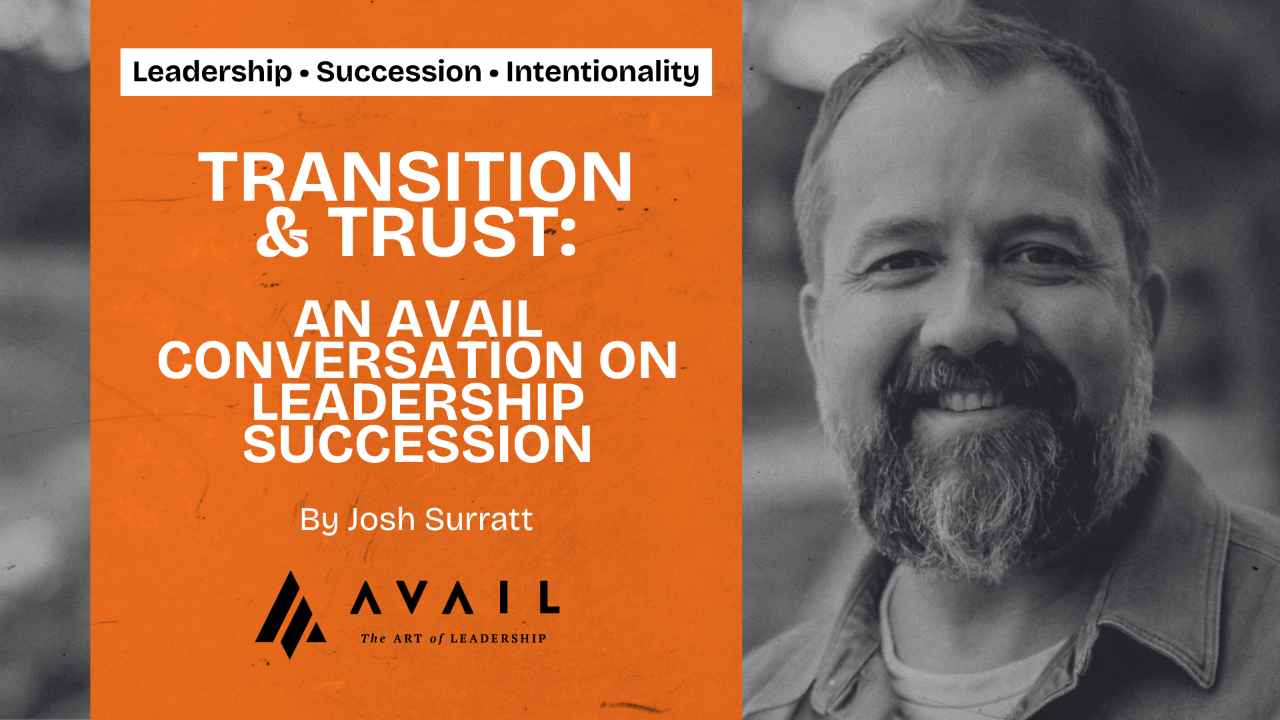
An AVAIL conversation on leadership succession
With Josh Surratt
Seacoast Church began in 1988 when a small group of believers gathered in an apartment clubhouse in the Charleston, South Carolina, area, led by founding pastor Greg Surratt and his wife, Debbie. From its humble beginnings, Seacoast quickly grew, driven by a vision to reach people far from God and to build a church that was both biblically grounded and culturally engaged.
Seacoast established its first permanent campus in nearby Mount Pleasant, now one of 15 campuses throughout South Carolina. More than three decades after its founding, Seacoast continues to influence churches and leaders nationwide, as one of the founding churches of ARC (Association of Related Churches), and maintains Greg and Debbie’s vision that it be “a church anyone could call home.”
The Surratts’ son Josh had been raised at Seacoast and notes that he was “radically saved” at the age of 18 in one of the congregation’s small groups. He came on staff in 2002 and served in several roles over the years, but Josh never envisioned he would one day take the leadership baton from his father. In fact, he recalls that when Gregg approached him with the plan, he told his dad he didn’t think it was a good idea.
That was 12 years ago, and Josh still sees his role as lead pastor as a temporary one that he will one day pass to the next generation. AVAIL media host Virgil Sierra recently sat down with Josh to discuss the topic of succession—the process of leadership transition that can sometimes cripple a church or organization, but which, when approached with grace and intentionality, can set the stage for future growth and impact.
AVAIL: What do you see as a good biblical picture of leadership succession?
Josh Surratt: I learned a lot about transition studying the life of David, and there are some easy things to pick out in that. You’ve got David and Solomon—and David had a lot of flaws, as we know. You’ve got this dynamic where David leveraged all his influence as an effective leader to build resources so that Solomon could then build the house of God and some things that weren’t David’s to build. David set the next generation up with so much opportunity to succeed in doing what God had called him to do. There aren’t any perfect pictures of transition, but that’s a beautiful picture. David wanted to build it, right? But God said, “No, you’re not.” But then David didn’t just give up. He actually leveraged his relationships to bring in the resources and to set up the next generation to be able to effectively lead. And in my case, I feel like my dad and the team here did such a good job of preparing the way so we could step in and lead and take the church to the next season.
AVAIL: From the standpoint of the person who’s passing the baton, what do you believe helps a succession plan be successful—or not successful?
Josh: My dad—I love him to death. He’s my hero, my role model. He wasn’t a perfect leader, but what he was able to do is detach his identity from his role as the founder and leader of Seacoast Church. And I think that’s a key thing, especially in our world. What I found in my dad is that he wasn’t so married to his job that he didn’t know who he would be after it. God has allowed it to be a church that’s reaching tens of thousands of people and that’s influencing a lot of people around the world—and we’re so grateful for that. But it never became my dad’s identity.
AVAIL: What about from the standpoint of those who are on the receiving end in succession?
Josh: Something I think is really key for success is honor. It’s not that hard to just show honor to the people who paved the way for us. And so, from the incoming leader, we come in and we’ve got all of this vision, and we’ve got all this desire to do things differently. We now have the opportunity—we’re sitting in the seat. And what I would tell incoming pastors is, for the first year, just be a pastor. Don’t even be a leader. I exaggerate that—I don’t mean it entirely. There are things you need to do, but if you would just focus that 80% of your job on sitting with people, having lunches with people, getting to know the key leaders in the church. Spend time with them because if you’ll do that, if you’ll pastor them, when you are ready to make some major changes or to tweak some things, or move in a new direction, you now have capital relationally with the people that you’re going to need to help make that happen.
AVAIL: I sense that you have a passion for helping pastors and churches through this process and through this journey. Can you share a little bit about that?
Josh: Part of why I’m passionate about it is just because of how much it’s blessed my life to be a part of it. And another thing that I would say is that there were a lot of the things that I considered weaknesses in me. I was a little bit of a reluctant leader, and I felt like I didn’t have that ambition to take it over. What I’ve learned in hindsight, now that I’ve been doing this for 11 years, is that what I thought were weaknesses actually were strengths and were what the church needed in that season. So, if you’re wondering whether you have what it takes to do the thing that God’s called you to do, welcome to life and ministry. God didn’t make a mistake when he created you. I just know how we as leaders get in our heads, how we doubt ourselves, how we question whether we have what it takes. But God is the one who did it, right? He didn’t make a mistake when He chose you for the role that He’s got you in. The sooner we become confident in that, the sooner that we will operate out of a place of His strength at work within our weaknesses, versus us trying to prove ourselves and prove to other people that we have what it takes.
AVAIL: One of the keys to a successful transition immediately after the passing of the baton is how we establish a healthy, caring culture. Why is church culture important, and how do you define church culture?
Josh: We love the church, small groups, the weekend—all of that. But the organization had grown to around 200 employees. While we did really well at church, we had no idea how to lead an organization. So, we did a survey through Best Christian Workplaces and discovered this was a great church that was growing, but the people that are working there were not healthy. As a result, now we spend a lot more time in staff meetings talking about health than we do about growth. I love growth—are we actually advancing the kingdom? If we’re not, let’s do something else. We want growth, but we spend so much more time talking about health than we do about growth. In our most recent survey—this past year—it was the first time we scored as a “flourishing Christian workplace.” That’s just one metric we use, but we’ve seen the culture grow as we’ve addressed some of the things that we identified here at Seacoast that make a difference. So we’ve gone on a journey of 11 years, and you know what’s crazy? As we’ve gotten healthier, the church is growing. To me it feels more sustainable.
AVAIL: Can you tell me more about what that sustainability looks like?
Josh: One of the things is that we have a platform culture, not a pedestal culture. Pedestals are narrow. They draw attention to themselves, and they’re easy to fall from. Platforms are wide. They’re for sending a message out, and there’s room for plenty of people on them. For example, we have a teaching team here at Seacoast. I preach, as a lead pastor, 15 to 18 times a year, which seems crazy. But it’s just something that we feel like God’s called us to do here. I don’t think it’s formulaic for every church, by any means, but it’s created a culture where we can stay fresh and healthy, and it’s not about me or any other name. It’s about proclaiming the message of Jesus to as many people as we can.
—
For more information on Josh Surratt and Seacoast Church, visit seacoast.org.

Stay up-to-date with all our upcoming releases!
Join our mailing list to receive the latest news and updates from us. Your information will not be shared.

Recent Posts

