
Holy Smoke
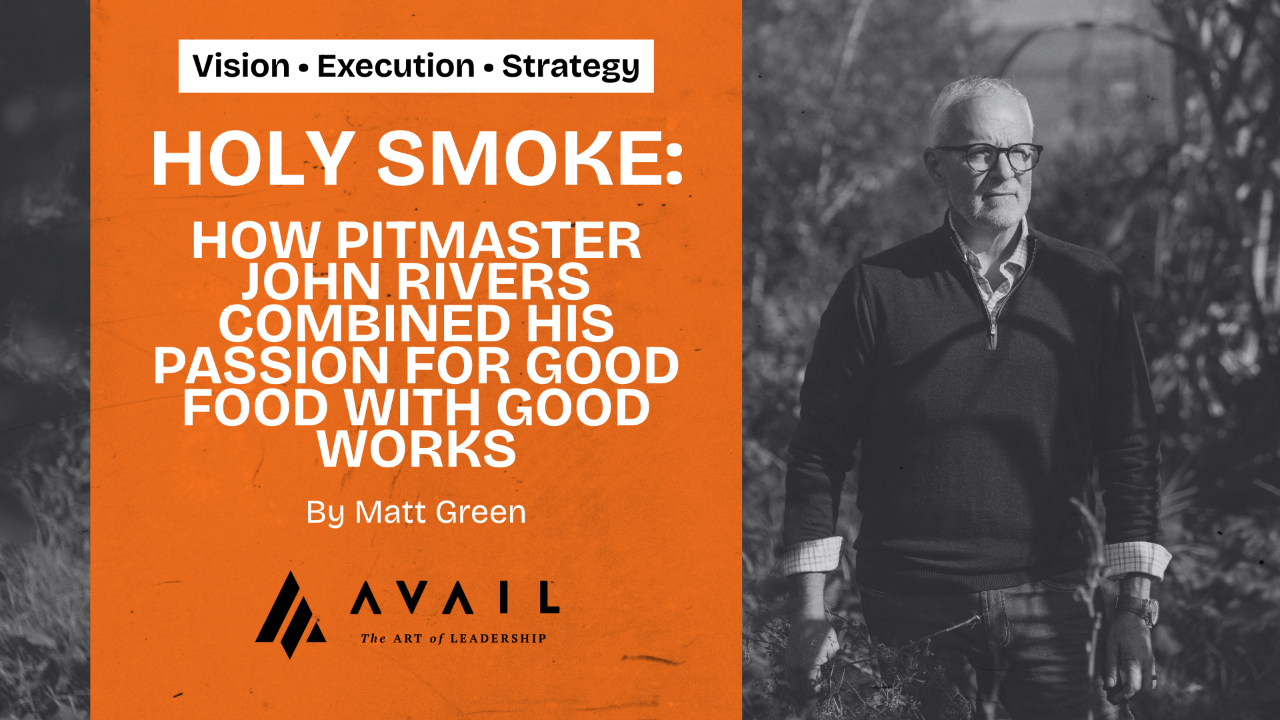
How pitmaster John Rivers combined his passion for good food with good works
By Matt Green
It was 2004, and John Rivers was nearly two decades into a successful career in health care, serving as president of a billion-dollar company where he oversaw operations and led teams. But beneath the surface of his achievements, something deeper stirred—a sense that the work, while meaningful, wasn’t his ultimate calling.
“I had a wonderful, blessed career,” Rivers recalls. “But I also knew there was more God wanted me to do. I just didn’t know what it was yet.”
The answer arrived in an unexpected form—a little girl in his community diagnosed with cancer. When her family declined financial help, Rivers offered to host a barbecue fundraiser instead. He’d always loved cooking, especially barbecue. It had been on a trip to Texas to visit his wife Monica’s relatives that John first tasted authentic, smoked brisket—a meal that made a lasting impression on him and later inspired his passion for barbecue.
“The fundraiser was much bigger than we ever anticipated,” he says. “We saw people coming together, we felt the joy of serving and I realized God was teaching me something through that experience. It wasn’t about the food—it was about the people.”
The cookout awakened in him a desire that couldn’t be satisfied by the corporate climb. For several years, Rivers continued to cook out of his garage, using his culinary hobby to serve others. The venture grew so large that he began wondering whether God was redirecting his life entirely.
When the healthcare company he helped build was sold, Rivers faced a choice: move into another corporate role or trust that God was opening a new door. “I could have stayed in healthcare,” he admits. “It was familiar, it was safe. But I knew in my spirit that season had ended. God was asking me to step out in faith.”
INTO THE UNKNOWN
Rivers retired early, and in 2009 opened the first 4 Rivers Smokehouse in a converted tire shop in Winter Park, Florida.
“We had no idea what we were doing,” he laughs. “But God did.” On opening day, lines wrapped around the block. Within weeks, the team was smoking over 1,000 pounds of meat a day. What started as a neighborhood fundraiser became a thriving restaurant group with more than 30 locations, three divisions and a nonprofit foundation.
He didn’t have a business plan—just a calling. “I remember praying, ‘God, I don’t know anything about running a restaurant,’” he says. “And what came to heart was, ‘You didn’t know anything about healthcare when you started either.’ That was enough for me.”
Looking back, Rivers sees that leap of faith as one of the defining moments of his life. “It wasn’t about escaping health care,” he says. “It was about obeying God’s redirection. Sometimes He has to pry you out of your comfort zone so you can step into your calling.”
Rivers doesn’t romanticize the risk—it came with fear, uncertainty and a real possibility of failure. But what sustained him was a conviction that the new venture wasn’t primarily about profit. “From the beginning, it was about serving people,” he says. “The business was the vehicle, not the destination. God had shown me what it looked like to integrate faith into work, and now He was giving me a chance to build something around that principle from the ground up.”
Today, when Rivers tells that story to young entrepreneurs or business leaders, he frames it as a leadership lesson about identity. “If your purpose is tied to your position, you’ll never be satisfied,” he says. “God’s calling isn’t about what you do—it’s about who you serve while you do it.”
What began as an act of obedience quickly grew into a thriving enterprise, but Rivers never saw the restaurant as the end goal. To him, 4 Rivers was a means of ministry disguised as a business. “A ministry doesn’t have to be nonprofit to minister to people,” he notes. “We just found a way to build one around barbecue.”
BUSINESS AS MINISTRY
Rivers’ use of the word ministry isn’t just branding—it’s conviction. “We were very blessed that we could actually build a business around the concept of giving back,” he explains. “The more brisket we sell, the more people we can help.”
Every 4 Rivers restaurant sets aside a budget strictly for community support. Local managers are empowered to use those funds to meet real needs—supporting families, churches and schools. “It’s not just corporate giving,” Rivers explains. “We want our teams to go into the community and find people who need help the most. It’s important that it’s personal. When they own it, they get it.”
His restaurants also double as gathering places—hosting Bible studies, prayer groups, even Sunday worship services before opening hours. New hires watch Rivers’ I Am Second testimony video and learn about the company’s faith-based culture from day one. “Our challenge as leaders,” he says, “isn’t keeping the ministry in place—it’s making sure everyone understands that’s why we exist.”
This philosophy has been tested by growth. “As we’ve expanded, the challenge hasn’t been scaling the operations,” he says. “It’s been scaling the culture. You can’t be everywhere, so you have to build systems that keep the mission alive. That’s why we start with story. Every new employee has to understand why we exist before they learn what we do.”
INCLUSIVE FAITH, CONSISTENT CHARACTER
As unapologetic as Rivers is about his faith, he’s equally committed to creating an inclusive workplace. “We never exclude anyone because they don’t believe what we believe,” he says. “We hire for values—that’s character.”
He’s quick to note that inclusivity doesn’t mean compromise. Every restaurant operates under the same guiding principles: no cursing, no smoking, respect for all people and space for spiritual curiosity. “We lead by example,” Rivers says. “Hopefully people will ask, ‘Why do we pray before meetings? Why do we give so much? Why do we have Scripture on the walls?’ When they ask, that’s when real conversations begin.”
Rivers points out that the real test of ministry isn’t measured in donations or community partnerships—it’s in the lives of the people who walk through his doors every day. As 4 Rivers grew, so did his conviction that business could be a training ground for character and calling. “We can feed people through food,” he says. “But we can also feed them through culture, mentorship and purpose.” That belief has shaped not just how Rivers runs his restaurants, but how he leads the next generation entrusted to his care.
MENTORING THE NEXT GENERATION
More than 80% of 4 Rivers employees are part-time—many in their first jobs. That, Rivers says, is both a challenge and a sacred opportunity. “They’re at a very influenceable stage in life,” he explains. “They’re figuring out relationships, school, careers. Our managers aren’t just managing a business; they’re investing in people.”
One of those investments is the company’s Family Fund—a voluntary giving program to which employees donate spare change matched dollar-for-dollar by 4 Rivers—which helps coworkers in crisis. More importantly, Rivers cultivates a culture of trust and mentorship. “People work for people,” he says. “They don’t stay for a paycheck if they’re unhappy. If you want your team to stay longer, build a relationship with them. Be intentional.”
In an industry notorious for 150% turnover, 4 Rivers hovers around 70%. But Rivers is quick to note the real success isn’t measured in retention—it’s transformation. “We get letters from former team members talking about how their lives changed,” he says. “Some found faith here. Some learned that business can care about people. That’s what matters.”
As Rivers poured into young leaders, he began to see a pattern: the same principles that guided people’s growth—nurture, patience and stewardship—were just as vital in caring for the world around them. “God doesn’t waste seasons,” he says. “What you learn about growing people, you can apply it to growing anything.” That realization became the seed of a new vision—one that would take him beyond the smokehouse and into the soil itself.
STEWARDSHIP OF CREATION
In recent years, Rivers has worked his way back in the food supply chain from brisket to sustainable farming and the soil that makes it possible. His latest venture, the 4Roots Farm Campus, blends agriculture, education and advocacy in a 42-acre experiment in creation care.
As he began to research the challenges faced by families in his home turf of Central Florida, Rivers discovered that one in five students in Orange County Public School system doesn’t know where his or her next meal will come from.
Although living in one of the wealthiest countries on the planet, American children are experiencing many diet-related illnesses, leading to shorter lifespans due in part to illnesses like diabetes and heart disease.
He also discovered that 98% of the farms in the United States are chemical dependent. While 0.1% of pesticides reach pests, the rest pollutes our ecosystem. As if to add insult to injury, despite 41 million Americans lacking consistent access to food, 30% of the food supply in the U.S. goes to waste every year.
What began as a feeding program for food-insecure students became a deeper calling to restore the health of both people and the planet. The farm now hosts school groups, research projects and sustainability startups—all aimed at rebuilding soil and inspiring stewardship.
At 4Roots Farm Campus in Orlando, school buses pull in every day. Students step off, often for their first encounter with a working farm. They learn how vegetables grow, how soil stays alive, how healthy food affects their bodies and how stewardship can be an act of worship.
“Some of these kids don’t even know that a tomato comes from the ground,” Rivers says. “When they discover that, and then learn how to cook it and why it matters, something clicks. They realize the world is a gift—and they’re part of taking care of it.”
For Rivers, that’s what it’s all about: connection. Between soil and soul, between food and faith, between business and ministry. “It all ties together,” he says. “God’s story starts in a garden. It ends in a city. Everything in between is about how we take care of what He’s given us.”
“God gave us this beautiful planet and told us to take care of it,” he says. “When I learned how our soil health affects our physical health, it was an aha moment. We’re not doing a good job with what He gave us.”
INNOVATION, CALLING AND COURAGE
Rivers calls himself an “inventor and creator,” not an operator. “I get bored doing the same thing,” he admits. “I love building, and I love challenges.” It’s that creative restlessness that’s driven every new chapter of his life.
From the first smokehouse to The Coop (his Southern comfort concept) to the sustainability-driven 4Roots Farm Campus, Rivers sees each new venture as a step of obedience, not ambition. “When the farm came to heart,” he recalls, “I wrote in my prayer journal, ‘God, I don’t know anything about farming.’ What came to heart was: ‘You didn’t know anything about restaurants either.’”
That trust has become a guiding principle. “It’s like the parable of the talents,” he says. “God gives each of us something to work with. If we do good with it—if we steward it well—He’ll give us more.”
Today, that “more” includes 42 Acres, a new portfolio of science-based companies focused on sustainability. The project combines his healthcare background, entrepreneurial instincts, and growing passion for regenerative agriculture. “We built a bioenzyme lab to engineer healthy bacteria for soil,” he explains. “Another company speeds up food composting from 60 days to 24 hours. Another one breaks down plastics and turns them back into soil.”
To Rivers, it all connects. “Healthcare, agriculture, the environment—it’s one system,” he says. “What’s good for the soil is good for the body. And what’s good for the body is good for the soul.”
FAITH AS FRAMEWORK FOR INNOVATION
Rivers’ entrepreneurial pursuits flow from his theology of stewardship. He doesn’t see innovation as self-expression, but as participation in creation. “God gave us this beautiful earth,” he says. “He surrounded us with everything we need to live a healthy, abundant life. The problem is, we’ve stopped taking care of it.”
That conviction motivates not only his business ventures, but his leadership philosophy. “As Christian leaders, we’re called to build, not just maintain,” Rivers notes. “We’re supposed to bring order to chaos, beauty to brokenness and hope to what feels hopeless. That’s what innovation really is—joining God in His creative work.”
He believes faith-driven entrepreneurship requires both courage and humility. “You have to be careful when you ask God what He created you for,” Rivers explains. “Because when He tells you, it’s not always easy. It takes courage to follow through.”
A LEADERSHIP CULTURE OF INTEGRITY AND IMPACT
Rivers’ leadership style has been shaped by mentors who modeled integrity over expedience. Early in his career, a Christian CEO in the health care industry showed him what it meant to live the same faith in the boardroom that he professed on Sunday. “He became my mentor,” Rivers recalls. “I watched how he was with his family, how he ran the business, how he always put what was right first. That’s when I realized faith and work weren’t separate buckets.”
He carries that conviction into his own leadership now. “I ask people, ‘Are you the same person at work that you are at home, that you are on Saturday night, that you are on Sunday morning?’ If the answer is no, then you’ve got some work to do,” he says. “Integrity is being the same person in all places.”
That consistency shows up in the culture he’s built. Every decision—from the way team members are treated to the way food is sourced—flows from the same values: integrity, generosity and service. “We didn’t start this to retire again,” Rivers says. “We started it to serve.”
For Rivers, leadership isn’t about control—it’s about trust. “You can’t lead through fear and expect people to thrive,” he says. “You have to create an environment where people know they’re loved, where they feel safe to grow and where they’re inspired to make a difference.”
REDEFINING SUCCESS
“Success for me is obedience,” Rivers says. “If God gives you something to do, and you do it with the right heart, that’s success.”
He’s grateful for the growth of 4 Rivers, but insists the real legacy lies elsewhere. “The letters I keep aren’t from customers,” he says. “They’re from employees. People who say they came to know faith here. People who say their lives changed. That’s what I want to be known for.”
Rivers is convinced that the next generation of leaders will need a broader definition of success—one rooted in stewardship rather than accumulation. “We’re called to take care of what we’ve been given,” he says. “That includes people, resources and the planet itself. It’s not ours—it’s His.”
With that in mind, Rivers sees himself less a businessman than a steward—a man trying to live faithfully in each season God gives. “You have to live your life moving forward,” he says, quoting Søren Kierkegaard. “But you only understand it looking back. When I look back, I see God’s hand in every step.”
—
Matt Green is the editorial director for AVAIL Journal. He also serves as vice president of marketing for Pioneers, a global church-planting organization based in Orlando, Florida. He lives in Central Florida with his wife, Andy. They have four children and one grandchild.

Stay up-to-date with all our upcoming releases!
Join our mailing list to receive the latest news and updates from us. Your information will not be shared.

Recent Posts

