
The Waymaker
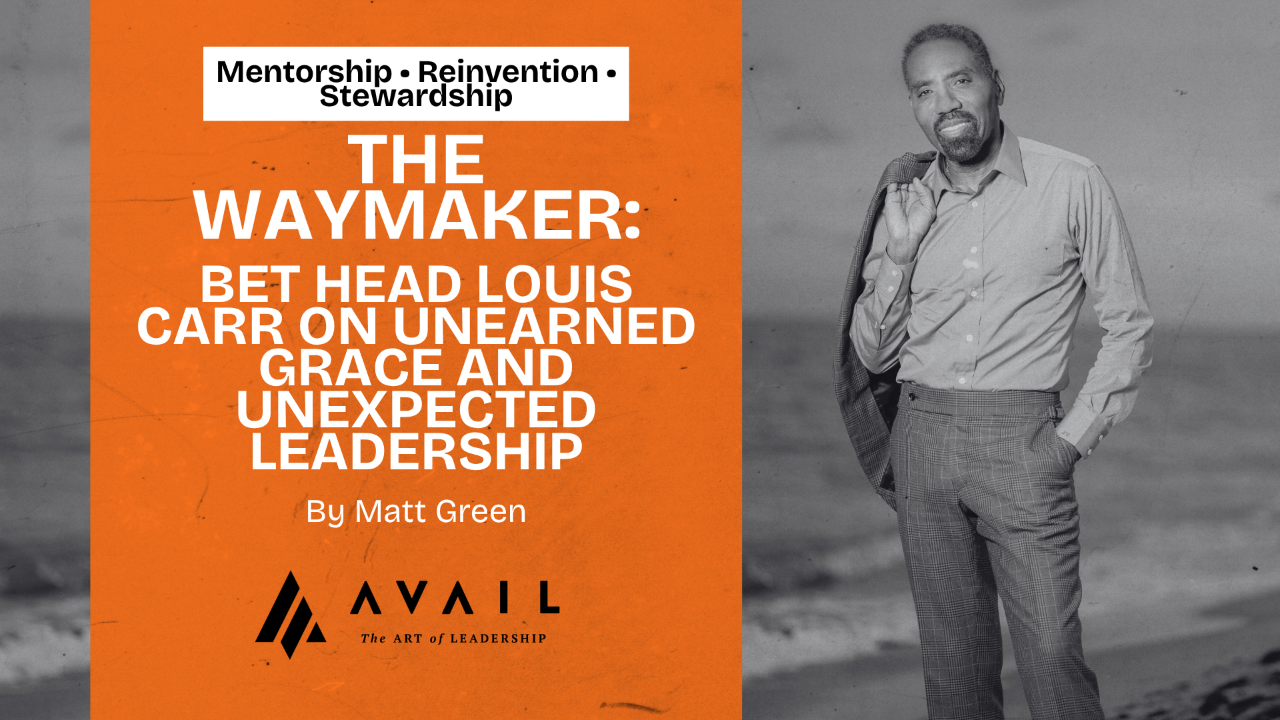
BET head Louis Carr on unearned grace and unexpected leadership
By Matt Green
Louis Carr thought he was done. It was late 2025, and after 39 years at BET (Black Entertainment Television), most recently as president of media sales, he was planning for retirement.
Carr’s career had placed him in rooms where global brands were shaped, leaders were developed and culture was debated. He had resigned his position and was preparing to step away. There were conversations about farewell gatherings, and loose ends were being tied up—a satisfying conclusion to a long and improbable run.
Then, a door opened he had not planned to walk through. In early December, Scott Mills, president and CEO of BET Media Group, announced his departure after 23 years, and Carr was tapped to fill the role.
“I didn’t work for it,” Carr says. “I didn’t ask for it. It just fell out of the sky.”
UNEARNED GRACE
This was not the first time he had experienced an unlikely turn of events. Growing up on the west side of Chicago, Carr attended Lane Technical High School, one of the largest and most competitive public high schools in the country.
By his senior year, Carr was captain of the track team and a nationally ranked sprinter. One day he wrote on a piece of paper the numbers 3:19.5—a time goal for a 4x400 meter relay—and handed it to his coach.
“I think we could run that,” Carr told his coach.
“If you run that, you’ll break the world record,” his coach replied.
“I think our team can break the world record,” Carr pushed back.
“I love that,” his coach responded, “but you’re not that good.”
Sure enough, on March 24, 1974, Carr’s relay team ran a 3-minute, 19.5-second 4x400-meter relay—breaking a world record that had stood for years. With college scholarships lined up, the young athlete went to bed that night on top of the world, his future seemingly locked in place.
The next day, when Carr raced again, it all vanished. He tore his hamstring so severely that doctors told him he might never walk without a limp. The injury was catastrophic, not just physically but vocationally. Scholarship offers evaporated almost overnight.
“I was ranked in the top three track athletes in the country, and in a short 60-yard run, my career was over. Done,” Carr recalls. “Teammates were crying, coaches crying. How could he be on top of the world one night and be at the bottom the next?”
Carr began adjusting his expectations.
“I thought, This is probably it,” Carr says. “I was moving on.”
Like many young men without wealth or safety nets, he did what seemed practical and began filling out job applications at UPS, the Chicago Transit Authority and FedEx. Then one afternoon, a neighborhood kid ran up to him in the park with a message: “Your mom says come home—it’s an emergency.”
“In the hood, when you hear that,” Carr notes, “you figure somebody died.”
Carr rushed back, bracing himself for bad news. When he arrived, a stranger was sitting in the living room. It was Ed Earhart, the athletic director and track coach at Drake University in Des Moines, Iowa.
Earhart explained that Phil Ferguson, a former Lane Tech athlete, had come to him with a question: “Do you have a scholarship left?” He told Earhart about a friend in Chicago who had been injured and left without options.
Earhart spent the day making calls, pulling old articles from the Chicago Tribune, checking the Chicago Defender, speaking with sportswriters and coaches who had followed Carr’s career. By the end of the day, the consensus was clear: If you’re ever going to take a chance, take it on this guy. Carr was offered a full five-year scholarship. School started the next week.
“I thought my story was over,” he says. “But it was really just being redirected.”
This—and countless other events in his life—Carr attributes to God’s grace intervening when he wasn’t looking for it.
“Clearly, it was something I didn’t work for. Clearly, it’s something I didn’t ask for. But clearly, that’s a plan God had for me,” he notes. “This guy, like manna from heaven, just fell out the sky. So that was the first inkling—that experience from being on top of the world, going to the bottom and then being rescued. That was my first, what I would call, spiritual reckoning that there was something greater happening that I didn’t control.”
Carr arrived in Des Moines as an outsider—geographically and culturally. Iowa was not Chicago, but he looks back at his time as a Bulldog as some of the best years of his life. At Drake, Carr rebuilt his identity piece by piece. He went on to become an All-American on the track, but the experience of nearly losing everything had changed him.
“I had to learn how to listen. Really listen,” he says. “I didn’t take anything for granted after that.”
EMBRACING FOLLOWERSHIP
Carr notes that he learned discipline and obedience from coaches who demanded consistency even when no one was watching and execution even when an explanation was incomplete.
“They didn’t care who you thought you were,” Carr says. “They cared if you did the work.”
That posture—following before leading—has shaped his leadership philosophy.
“That’s where leadership really started for me,” Carr says. “Not when I was in charge—but when I wasn’t.”
Carr often returns to a moment from his high school years to explain what that kind of followership looks like. After his injury, Carr’s coach insisted he run in the state meet, even though the young athlete was still limping. Carr protested, afraid of failing publicly.
“He told me, ‘You’re the captain,’” Carr recalls. “‘You don’t get to sit this out.’”
Carr ran, and against expectation he recorded the fastest time in the state.
“The limp came back the next day,” Carr says. “But the lesson stayed.”
For Carr, that moment clarified something he would carry into every leadership role that followed: obedience does not guarantee outcomes, but it does shape character.
“Leadership came to me because I’m a good follower,” he says. “I know what it means to trust someone else before asking people to trust me.”
Today, as he leads his team and mentors young people, Carr doesn’t focus on vision or disruption—common leadership tropes. He speaks instead about execution, discipline and faithfulness—showing up when it would be easier to step back.
“You don’t learn that when you’re in charge,” he says. “You learn it when you’re accountable to somebody else.”
After graduating from Drake, Carr worked as a customer service representative for Bankers Life Insurance Company until 1980, when he joined New York Life Insurance Company. Then, in 1984, he landed a job as a salesman at Johnson Publishing Company. It was at the historic parent company of Jet and Ebony magazines that he cut his teeth on ad sales and marketing, and soon after, was invited to work for Black Enterprise magazine.
While at Johnson Publishing, Carr was recruited to work at BET. Founded in 1980 by media entrepreneur Robert L. Johnson, BET had the aim of creating a national television platform that centered Black audiences—something that did not meaningfully exist in American cable television at the time.
Self-described as being blessed with “the gift of gab,” Carr was drawn to broadcast journalism.
“Back then, before somebody told me better, I thought I was a handsome guy and that I could be in front of a camera,” he recalls, laughing. “Later on, women told me that I wasn’t so handsome and that I didn’t need to be before the camera.”
BUILDING AN INSTITUTION
In 1983, BET became a 24-hour cable network, making it the first Black-owned company to achieve that scale in television. Its early programming included music videos, news and public affairs content and cultural programming that reflected Black life and perspectives often ignored or marginalized by mainstream networks.
When Carr joined BET in 1986, multicultural marketing was still viewed as a niche rather than a necessity. He learned the business from the inside—how brands worked and how cultural insight could either be leveraged responsibly or ignored entirely.
“What does this brand mean to the people who watch it? And what responsibility comes with that?” Carr recalls asking in the early days. “You had to know how to listen—to the client, to the culture, to what wasn’t being said.”
For Carr, BET is not simply a media brand or entertainment outlet, but a cultural institution that carries memory, identity and responsibility. That reality shapes how he approaches decision-making.
“You have to respect what it means to people,” he explains. “This isn’t just content. This is history. This is voice.”
Carr came of age professionally alongside BET’s growth, and he watched the network become a central gathering place for Black audiences—particularly at moments when representation elsewhere was scarce or distorted. That history, he believes, creates obligation.
“When people see themselves reflected somewhere for the first time, that matters,” Carr says. “You can’t treat that lightly.”
His early roles focused on advertising sales and partnerships—work that required building trust with corporations while advocating for a network that served a community often misunderstood by mainstream media. Carr notes that he learned how to translate cultural value into business language without diluting its meaning.
“You couldn’t oversell,” he says. “And you couldn’t apologize either.”
STORY, TRUTH AND CULTURAL WITNESS
Although the majority of Carr’s career has been in media sales, he sees storytelling at the heart of his leadership philosophy. Technology may change the medium, but the need for voice remains.
“Storytelling will never die,” Carr insists, “because at some point, you have to speak for yourself.”
At a time when stories are often shaped and curated by digital algorithms, siloed in tribalized channels of content or even generated out of thin air from large language models by artificial intelligence, Carr argues that a leader must be able to tell a compelling story that resonates across audiences.
“Clearly we are in one of those environments right now in which storytelling is important. Two people can experience the same event, but see it differently,” he notes. “Both of those stories deserve to be heard.”
Perspective shapes truth, and truth must be told freely if it is to be trusted, he says. A leader’s job is to tell familiar stories with a new voice.
“On Easter Sunday,” Carr notes. “Everybody knows what the story’s gonna be in every single church. Everybody knows it. You’ve heard it I don’t know how many times,” Carr notes. “But the way it is communicated is different in every single church. It’s the same story. But the way it’s told—that’s where meaning shows up.”
THE WAYMAKERS
Looking back at his career, Carr is quick to point out that none of his successes were accomplished alone. In fact, he can name 19 “waymakers”—people who altered the trajectory of his life.
“I describe a waymaker as somebody who sees something in you that you don’t see in yourself,” he explains, “and they decide to do something about it.”
The term came to Carr during the pandemic, when he heard a pastor’s wife preach a sermon titled “What Is a Waymaker?” The phrase landed immediately. It defined the coaches, teachers, bosses, family members, colleagues who had stepped in and redirected the course of his own life—beginning with the teammate who spoke up at Drake and a coach who took a risk.
“They didn’t just encourage me,” Carr says. “They intervened.”
He explains that the waymakers in his life have given him a sense of obligation to be a waymaker for others.
“I’m paying interest on a debt that can never be repaid,” Carr says.
One concrete way Carr is “paying interest” is through the Louis Carr Foundation, which provides up to 12 paid internships in communications to undergraduate students of color during the summer immediately following their freshman, sophomore or junior year of college.
Carr established the foundation in 2003 to increase multiculturalism and diversity in the communications industry. Over the years, he had observed segments of the industry such as advertising, marketing, public relations and media sales were slow to develop the multi-ethnic workforce, even as the population—and the world—became more multicultural.
Carr often tells the story of a young intern who wanted to quit because she felt inferior to peers from Ivy League schools. She was embarrassed by her HBCU (historically Black colleges and universities) education, convinced it marked her as lesser. Carr stopped her and asked her to explain the history of her school—why it existed, who it served and what it represented. As she spoke, her posture changed.
“Now listen to yourself,” Carr told her. “Are you embarrassed—or are you proud?”
Reframing, he believes, is one of the greatest gifts a waymaker can offer.
Carr poured the same passion for mentoring young professionals into his 2006 book Dirty Little Secrets. In it, he set out to name the unspoken rules of professional life—lessons he believed too many people were forced to learn the hard way. His goal was to make unspoken professional rules explicit.
He notes that many talented people fail not because of ability, but because they were never taught the “rules of the game”—rules others absorb informally through proximity, privilege or mentorship.
More recently, Carr launched the WayMaker Summit, a gathering designed to create space for reflection, formation and connection—particularly among Black men navigating leadership, work and personal life. Although the summit brings together voices from across culture and leadership—NBA star Kyrie Irving, media mogul Nick Cannon, civil rights attorney Ben Crump, GRAMMY-winning artist Kirk Franklin and others, Carr is careful not to build it around celebrity or spectacle. Instead, its emphasis is practical and personal: wellness, discipline, financial stewardship, mentorship and the interior work required to lead well.
“What I am trying to do is educate, inspire and motivate men to be their best self,” he explains. “Not just for themselves, but also for their families and their communities.”
THE ART OF REINVENTION
As Carr reflects on his career—and the seismic cultural and technological transformations that have defined the decades since he began at BET, he believes these changes have prevented him from clinging to past success.
“I love change for the sake of change,” he says. “I really do.”
Although media roles are not known for longevity, Carr has remained influential in the midst of disruption. He attributes that durability to a trait that he says surprises people: reinvention.
“I’ve always believed you have to be willing to reinvent yourself,” he says. “The minute you get comfortable, you’re already behind.”
Carr describes reinvention as responsiveness rather than chasing the newest, hottest trend. Learning new systems, listening to younger voices and releasing roles when it was time were a recipe for longevity.
“It’s about humility,” he says, “and being willing to learn again.”
When the call came last December to step into the role of CEO at BET, Carr didn’t see it as the fruit of his ambition but the result of stewardship.
“I never thought in terms of climbing,” he says. “I thought in terms of staying faithful.”
—
Matt Green is the editorial director for AVAIL Journal. He also serves as vice president of marketing for Pioneers, a global church-planting organization based in Orlando, Florida. He lives in Central Florida with his wife, Andy. They have four children and one grandchild.

Stay up-to-date with all our upcoming releases!
Join our mailing list to receive the latest news and updates from us. Your information will not be shared.

Recent Posts

